Is an AI Receptionist Right for Your Small Business?
Is an AI Receptionist Right for Your Small Business?
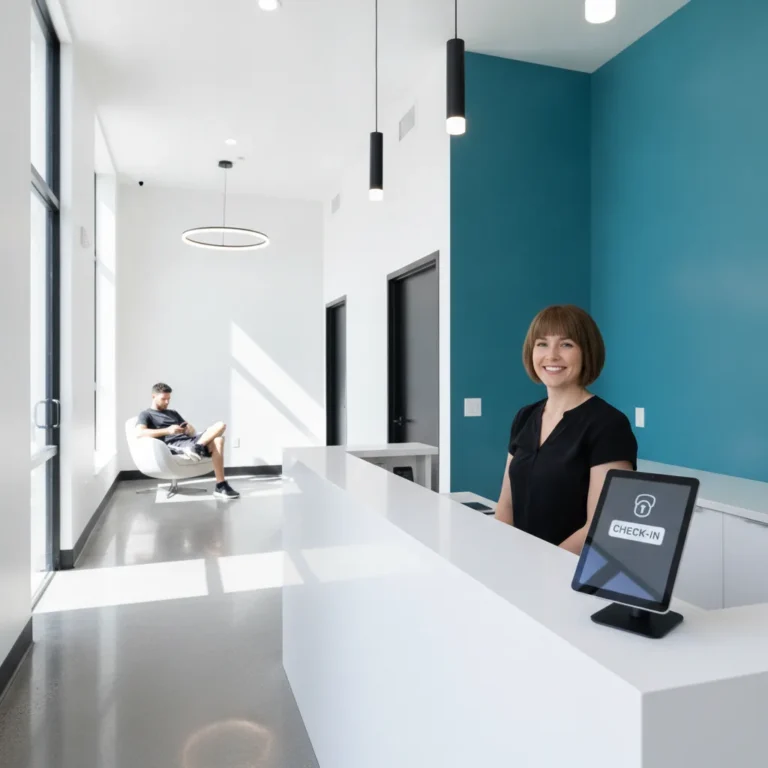
An AI receptionist for small businesses is a voice or chat-based system that answers calls, qualifies leads, books appointments and handles routine enquiries automatically, 24 hours a day. It suits owner-led businesses that are missing calls, spending hours on phone admin, or paying for reception cover they can barely justify. The right fit depends on your call volume, your customer expectations and where your time is currently leaking.
What does an AI receptionist for small businesses actually do?
An AI receptionist answers inbound calls in real time, responds to common questions using information about your business, routes urgent matters to the right person, and captures lead details without you lifting the phone. Unlike a voicemail, it holds a natural two-way conversation and can book appointments directly into your calendar or CRM.
Think of the typical morning in an owner-led trade or professional services business. You are on a job, in a client meeting or simply trying to focus, and the phone rings. You ignore it. The caller hangs up after four rings and calls your competitor instead. Research consistently shows that the majority of callers who reach voicemail do not leave a message, and most of those callers never ring back. An AI receptionist solves that specific problem by picking up every single time, saying the right thing and moving the conversation forward.
Modern AI reception systems can handle a surprisingly wide range of tasks. They greet callers in your business’s name and tone, answer questions about services, pricing and hours, screen out time-wasters, collect contact details, send follow-up texts or emails, and escalate genuine emergencies to a real person. The best ones integrate with tools like Google Calendar, HubSpot or your existing job management software, so nothing falls through the cracks between the call ending and the work being scheduled.
Why is owner dependency on the phone such a costly problem?
Owner dependency on the phone is costly because every call the owner handles personally pulls them away from billable work, strategic decisions or the tasks only they can do. A single missed or mishandled call can represent hundreds or thousands of dollars in lost revenue, yet hiring a full-time receptionist to solve the problem often costs far more than the problem warrants.
This is one of the seven core areas that owner-led businesses consistently struggle with: the owner is the system. If you are the one who answers the phone, qualifies the lead, makes the booking and follows up, then the business cannot run without you. That matters when you want to take a week off. It matters even more when you are thinking about selling, because a buyer will pay significantly less for a business that collapses the moment the current owner steps away.
A full-time receptionist in Australia typically costs between $55,000 and $75,000 per year in salary alone, before superannuation, leave entitlements and the overhead of managing another employee. A part-time option still requires rostering, training and cover for sick days. An AI receptionist operates at a fraction of that cost, never calls in sick, and does not need two weeks to get up to speed on your service list.
Which types of small businesses benefit most from AI reception?
Small businesses that benefit most from AI reception are those with high inbound call volume, time-sensitive leads, after-hours enquiries or a single owner who physically cannot answer every call. Trades, allied health, legal practices, real estate, home services and professional services firms consistently see the strongest return.
Consider a plumbing business receiving 30 calls a day. The owner is on tools from 7 am to 4 pm and cannot answer most of them. A qualified competitor answers immediately. With an AI receptionist, every call is answered, the urgent jobs are flagged for a callback within minutes, and the routine bookings are handled without the owner ever picking up the phone. The same logic applies to a physio clinic managing appointment requests between sessions, or an accountancy firm fielding queries during tax season when every team member is at capacity.
Businesses that are less suited to AI reception tend to be those where almost every call requires nuanced, complex judgment that changes significantly from caller to caller, or where the personal relationship with a known contact is so central that callers would actively resist speaking to anything other than a familiar voice. Even in those cases, an AI can handle the initial greeting and triage before warm-transferring to a human.
How does an AI receptionist fit into a broader business systemisation strategy?
An AI receptionist fits into a broader systemisation strategy as the front-end layer of your lead and customer communication system. It captures and qualifies inbound interest so that the rest of your sales, fulfilment and follow-up processes have clean, complete information to work with, rather than sticky notes and missed-call notifications.
At Sellstack AI, the approach to fixing owner-led businesses follows a clear sequence: fix the foundations first, then automate, then layer AI on top. An AI receptionist sits firmly in that automation and AI phase. It only works well when there are clear answers for it to give, a process for it to follow, and a system for the information it collects to flow into. If the business behind it is still chaotic, an AI receptionist will automate chaos rather than solve it.
That is why it is worth thinking about reception AI not as a standalone product but as one piece of a larger operating system for your business. When your services are documented, your pricing is clear, your booking process is defined and your CRM is set up, an AI receptionist becomes a genuine force multiplier. It handles the inbound volume so your team, or just you, can focus on the work that actually earns revenue.
What should you look for when evaluating an AI receptionist for small businesses?
When evaluating an AI receptionist for small businesses, look for natural conversation quality, integration with your existing calendar and CRM, the ability to customise responses to match your brand voice, transparent escalation pathways to a human, and clear reporting on call volume and outcomes. Avoid systems that sound robotic, give generic answers or cannot hand off smoothly when a caller needs a real person.
Test any system with the three or four questions your callers ask most often. If the AI stumbles, gives a wrong answer or deflects unhelpfully, that is what your customers will experience. The setup process matters too. A good AI reception solution should require a reasonable amount of configuration upfront, because that is how it learns your business, but the ongoing maintenance burden should be minimal.
Ask whether the system can handle interruptions and natural speech patterns. Real callers talk over automated systems, change their question mid-sentence and use shorthand for your services. A voice AI that handles that gracefully feels like a legitimate extension of your team. One that requires callers to speak slowly and clearly into a robotic menu will generate complaints before the end of the first week.
The business case is straightforward to test. Take your average job value, estimate how many calls you miss or mishandle in a month, and apply even a conservative conversion rate to the calls you would have captured. For most small businesses, recovering two or three jobs a month more than covers the cost of a good AI reception system.
If you want to see what a well-configured voice AI and AI reception system looks like in practice, Book a Voice AI and AI reception demo with Sellstack AI.